How to Build Running Periodization: A Practical Guide to Improve with Consistency
Learn how to build running periodization with base, development, sharpening, and recovery phases to train smarter, avoid injuries, and improve performance.
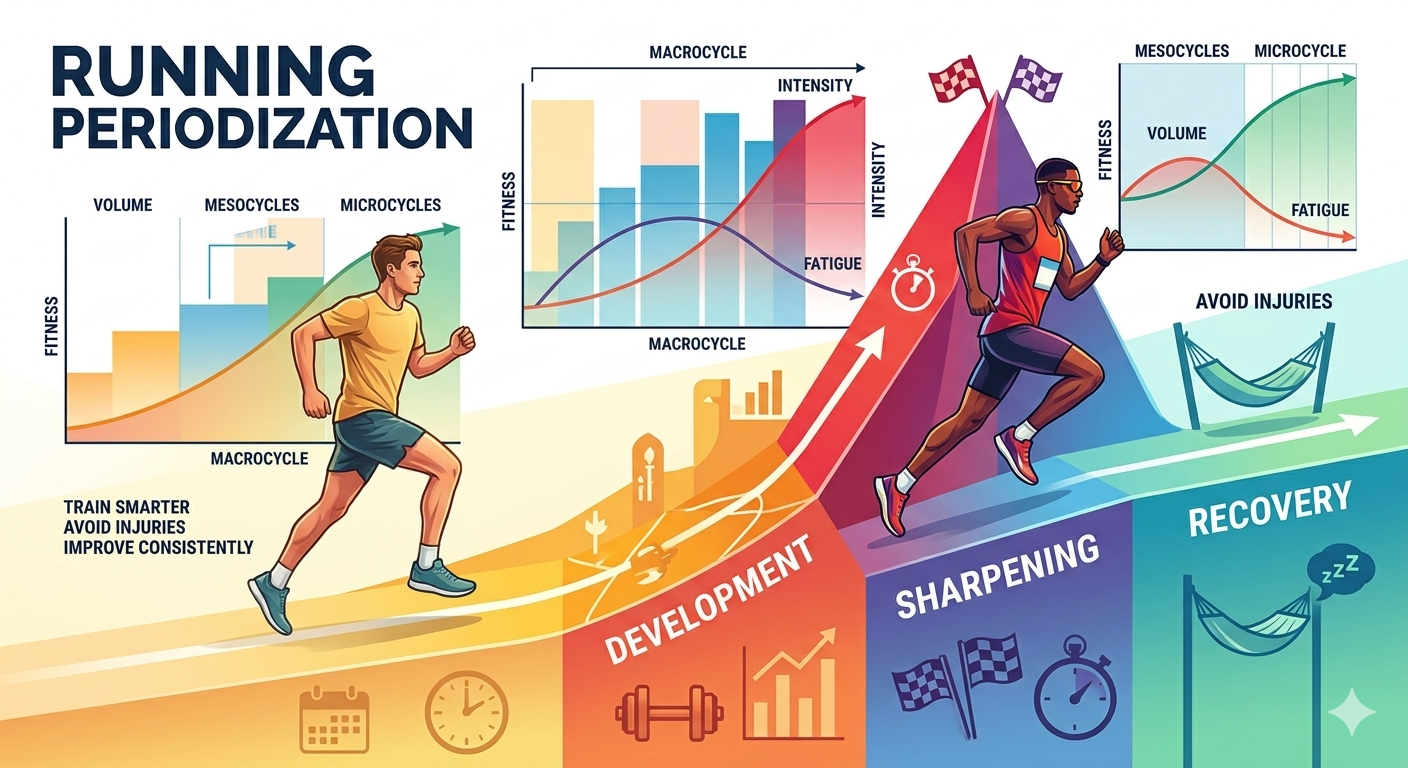
How to Build Running Periodization: A Practical Guide to Improve with Consistency
Introduction
If you feel like you train a lot but improve very little, the issue is often not lack of effort. The problem is usually lack of structure. In running, progress does not come simply from doing more miles. It comes from applying the right stimulus at the right time, with enough recovery to actually absorb the work.
That is where running periodization matters. Think of it as a roadmap for performance. Instead of training randomly and hoping for improvement, you organize your weeks and months into blocks with specific purposes. One phase builds your aerobic engine. Another improves threshold and race rhythm. Another sharpens you for competition. And all of them work together.
For runners of any level, periodization helps with three major goals:
- improving consistently
- reducing injury risk
- arriving at race day better prepared
It is not a system reserved for elite athletes. It is simply the smartest way to turn training into progress.
What Running Periodization Is and Why It Works
Periodization is the planned organization of training over time to produce specific adaptations. Instead of repeating the same week forever, you manipulate volume, intensity, frequency, and recovery according to your main goal.
The body does not adapt well to chaos
The body responds to training through biological logic. If you stack hard workouts all the time, fatigue accumulates, quality drops, and progress slows. If everything is easy, you may stay healthy, but you leave performance on the table. Periodization helps balance those two realities.
In running, performance depends on multiple components:
- aerobic base
- running economy
- lactate threshold
- VO2 max
- muscular durability
- recovery capacity
You cannot emphasize all of them equally at the same time. A good plan defines what to prioritize in each phase.
Macrocycle, mesocycle, and microcycle
A practical way to understand the structure is this:
- Macrocycle: the big-picture cycle, usually several months leading to a goal race
- Mesocycle: medium blocks of about 3 to 6 weeks with a specific focus
- Microcycle: the weekly structure where the training actually happens
Think of the macrocycle as the season, the mesocycle as the construction block, and the microcycle as the weekly brickwork.
How to Build Running Periodization in Practice
1. Define the goal race and your starting point
Before you build any training cycle, answer two questions:
- What is the target race?
- What is your current level?
A plan for a 5K is not the same as one for a 10K, half marathon, or marathon. In the same way, a runner who already handles five runs per week can tolerate a different load than someone still adapting to three sessions.
Assess:
- current weekly volume
- training history
- injury history
- available training days
- current race performances
- recovery capacity
This is where smart planning begins. Training that looks good on paper but ignores your reality usually fails in practice.
2. Divide training into phases
A classic and highly effective structure for runners looks like this.
Base phase
The goal is to build aerobic capacity and structural durability.
Priorities include:
- easy runs
- gradual volume progression
- strength training
- running drills
- weekly consistency
This phase is the foundation. If the base is weak, every harder phase becomes unstable.
Development phase
The goal is to improve threshold, rhythm, and efficiency at moderate to high intensities.
This is where you can include:
- tempo runs
- controlled intervals
- progression runs
- long runs with moderate segments
This phase converts general fitness into more specific performance.
Specific phase
The goal is to prepare for the actual demands of the race.
That means bringing training closer to competition reality through:
- race-pace sessions
- specific long runs
- pacing strategy practice
- workouts that simulate race demands
If the base builds the engine, the specific phase teaches you how to use it under pressure.
Taper phase
The goal is to reduce fatigue without losing sharpness.
During tapering, overall volume drops, but you still keep enough intensity to stay responsive. Many runners get this wrong: either they rest too much and feel flat, or they keep pushing and arrive tired on race day. Good tapering is not about doing nothing. It is about arriving fresh without losing rhythm.
How to Distribute Intensity Without Overdoing It
One of the most common mistakes among recreational runners is turning every week into a test. Endurance training usually works best when most of the work stays easy and only a smaller portion is truly demanding.
A useful distribution is often:
- 70% to 85% of total volume at easy intensity
- 15% to 30% at moderate to high intensity, depending on the phase and athlete level
This means your easy runs need to be genuinely easy. That is how you build volume, improve aerobic adaptations, and stay fresh enough to execute quality sessions well.
Practical Application
Simple 12-week running periodization example
Weeks 1 to 4: base
- 3 to 5 runs per week
- focus on easy mileage
- 1 technique or drill session
- gradually longer long run
- strength training 2 times per week
Weeks 5 to 8: development
- maintain volume
- 1 tempo session per week
- 1 controlled interval session
- long run with moderate segments
- recovery week built into the block
Weeks 9 to 10: specific phase
- more race-pace work
- less “junk volume”
- more precise pace execution
- long run aligned with race demands
Weeks 11 to 12: taper
- progressive volume reduction
- maintain some intensity
- prioritize sleep, recovery, and freshness
Checklist for building your running periodization
- define the goal race
- set a realistic number of weekly sessions
- organize phases with clear objectives
- increase volume gradually
- alternate loading and recovery
- include strength and mobility
- monitor fatigue signals
- adjust the plan based on how your body responds
Common mistakes
- running too hard on easy days
- increasing volume and intensity at the same time
- copying a plan without considering your own routine
- ignoring sleep, stress, and recovery
- skipping deload weeks
- trying to win workouts instead of building fitness
Every athlete is unique. Training load, nutrition, and recovery should be individualized when possible with the support of a qualified coach, sports nutritionist, or physician, especially for ambitious goals or a history of injury.
Conclusion and CTA
Building good running periodization is not about making training more complicated. It is about giving the process logic. When you organize base, development, race-specific work, and taper correctly, your body receives the right stimulus at the right time. That is often the difference between training hard and actually getting better.
Whether your goal is a 5K, 10K, half marathon, or marathon, the principle stays the same: consistency first, specificity second. A few hard weeks may feel productive, but a well-structured season is what creates lasting progress.
If you want, I can also turn this into a more technical version, a more commercial SEO version, or a race-specific article for 5K, 10K, half marathon, or marathon.
FAQ
- What is running periodization?
It is the organization of training into phases over weeks or months, each with a specific purpose, to improve performance and reduce injury risk.
- How long should a running periodization cycle last?
It depends on the race and the runner, but 8 to 16 weeks is common for goals such as the 5K, 10K, and half marathon.
- Do beginners need periodization?
Yes. Even with a simple structure, beginners benefit from planned progression, adaptation, and recovery.
- Can I do hard workouts every week?
You can include hard sessions weekly, but not every day. Improvement comes from balancing stress and recovery.
- How do I know if I am increasing training load too quickly?
Common signs include heavy legs all the time, declining performance, poor sleep, persistent soreness, and low motivation.
- Does the long run belong only in marathon training?
No. The long run can be useful across multiple distances, but its role changes. In base training it builds endurance, and in specific phases it helps simulate race demands.
- Is tapering important even for shorter races?
Yes. Even for shorter races, reducing fatigue before competition can improve freshness and performance.