FTP in Cycling: What It Is, How to Calculate It, and How to Improve It
Understand what FTP in cycling is, how to calculate this performance metric, and which strategies really help raise your functional power in training.
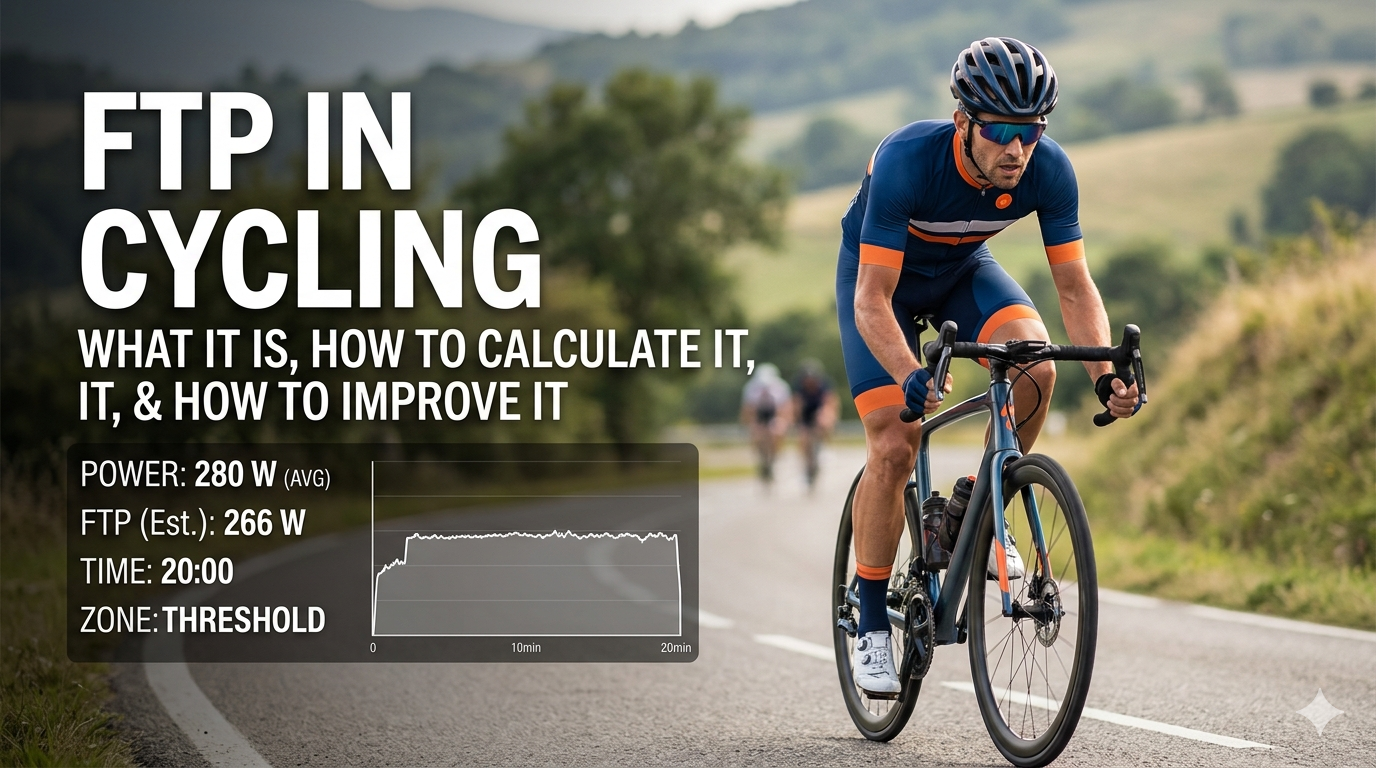
FTP in Cycling: What It Is, How to Calculate It, and How to Improve It
Introduction
If you ride regularly, you have probably heard someone say, “my FTP went up” or “let’s adjust your zones based on FTP.” In modern cycling, especially in power-based training, this is one of the most widely used metrics to organize load, intensity, and progression.
But here is the point many people miss: FTP is not just a number to show off in an app. It is a practical reference for understanding how much power you can sustain in a hard but controlled effort. In other words, it helps answer a central question for any cyclist: how hard can you ride in a sustained way without blowing up?
Think of FTP as the aggressive cruising speed of your performance. It is not a sprint, it is not a recovery spin, and it is not that suicidal effort that only lasts a few minutes. It is the intensity that separates well-calibrated training from training based on guesswork.
What FTP Is in Cycling
FTP stands for Functional Threshold Power. In practical terms, it is the highest average power a cyclist can sustain for a prolonged period, traditionally associated with something close to 60 minutes of maximum steady effort.
In day-to-day training, FTP is used as a training reference, not as an absolute physiological truth. It helps you:
- Define power zones
- Control intensity
- Compare progress over time
- Plan specific sessions
- Adjust training load more precisely
Is FTP the same as threshold?
Not exactly. FTP is a functional approximation of what happens near your physiological threshold, but it does not replace more complete laboratory evaluations. Even so, for most cyclists and triathletes, it is extremely useful because it combines practicality with strong real-world training application.
It is like using a reliable gauge on a car dashboard: it may not tell you everything about the engine, but it helps you drive much better.
How to Calculate FTP
There are several ways to estimate FTP, but the most popular is the 20-minute test.
Most common method: the 20-minute test
The classic protocol usually follows this logic:
- Do a good warm-up
- Perform a few short efforts to activate the system
- Ride 20 minutes at the maximum sustainable effort
- Take the average power from those 20 minutes
- Multiply it by 0.95
The formula looks like this:
$$FTP \approx Average\ Power\ for\ 20\ min \times 0.95$$
Practical example
If you averaged 280 watts for 20 minutes:
$$FTP \approx 280 \times 0.95 = 266\ watts$$
Your estimated FTP would be 266 watts.
Other commonly used methods
Besides the 20-minute test, there are also:
- Ramp tests
- 2 x 8-minute tests
- Automatic modeling in training platforms
- Estimates based on your history of maximal efforts
All of them can be useful, but the most important factor is consistency of method. If you keep changing protocols, it becomes much harder to compare progress.
How to Interpret FTP in Practice
The absolute FTP value already says something, but by itself it does not tell the whole story. What really matters is context.
1. Absolute FTP
This is the raw number in watts, such as 250 W, 300 W, or 340 W. It is especially useful in flat races, time trials, and situations where total power matters a lot.
2. Relative FTP
This is the relationship between FTP and body weight:
$$Relative\ FTP = \frac{FTP}{body\ weight\ in\ kg}$$
If a cyclist has 266 W and weighs 70 kg:
$$\frac{266}{70} \approx 3.8\ W/kg$$
This number is especially relevant in climbs because it shows how much power you produce per kilogram of body mass.
3. FTP is not the whole performance picture
A common mistake is to think that raising FTP solves everything. It does not. Cycling performance also depends on:
- Pedaling economy
- Aerobic capacity
- Lactate tolerance
- Recovery
- Nutrition and hydration
- Race tactics
- Aerodynamics
- Mental resilience
FTP is an important metric, but it is not the entire athlete.
How to Improve FTP
Here is the part that really matters: how to increase FTP without turning every workout into random suffering.
Aerobic base comes first
Without a solid base, the body cannot sustain performance development. Before chasing very intense sessions, you need to build:
- Consistent volume
- Low- to moderate-intensity training
- Good recovery
- Weekly consistency
This is the classic endurance logic: first you build the engine, then you learn how to use it at high revs.
Training near threshold
The most classic workouts to improve FTP usually target intensities close to threshold, with sustained blocks. Examples include:
- 2 x 20 min close to FTP
- 3 x 12 min at threshold intensity
- 4 x 8 min hard but controlled
- Sweet spot around 88% to 94% of FTP
These sessions help the body tolerate prolonged efforts better and improve the ability to sustain power efficiently.
VO2 max and power above threshold
For some athletes, improving FTP also means raising the physiological ceiling. Sessions above threshold, when well distributed, can help with that. But this is important: this type of training demands more recovery and should not dominate the entire week.
Recovery also helps FTP rise
Many athletes try to increase FTP by training harder every single day. That usually leads to chronic fatigue, lower quality, and stagnation.
What actually makes you improve is not just the stimulus. It is the combination of:
- Stimulus
- Recovery
- Adaptation
Without rest, there is no supercompensation.
Every athlete is unique. FTP interpretation and ideal training prescription should consider your background, routine, recovery, and the guidance of a coach, physician, and sports nutritionist whenever possible.
Practical Application
Example of how to use FTP in training
After calculating FTP, you can organize your zones and guide your sessions more logically. This makes training less emotional and much more objective.
Checklist for using FTP the right way
- Do the test when rested
- Use a similar protocol every time
- Adjust your zones after each new test
- Reassess every 6 to 10 weeks
- Monitor perceived exertion and heart rate
- Compare FTP with your real-world performance on the road or trainer
Common mistakes
- Testing while fatigued
- Overestimating the result بسبب excitement
- Using an outdated FTP for months
- Training at the limit all the time
- Ignoring sleep, nutrition, and recovery
- Confusing a nice-looking number with sustainable progress
Conclusion and Call to Action (CTA)
FTP in cycling is one of the most useful tools for turning training into strategy. It helps you understand your current level, adjust zones more precisely, and track progress without relying only on feel.
But the most important point is this: FTP improves through intelligent consistency, not weekend heroics. If you want to raise your functional power, think like an endurance athlete: build the base, organize intensity, respect recovery, and repeat the process with discipline.
If you want, I can also turn this into a more publication-ready blog version, optimized for featured snippets, or create a full content cluster around power, training zones, and cycling performance.
FAQ
- What is FTP in cycling?
It is Functional Threshold Power, used as a practical reference to estimate the highest power a cyclist can sustain for a prolonged period at a hard and steady intensity.
- How do you calculate FTP in a simple way?
The most popular method is to do a 20-minute test, take the average power, and multiply it by 0.95.
- Is FTP the same as lactate threshold?
Not exactly. FTP is a functional estimate that is very useful for training, but it does not replace complete physiological laboratory testing.
- How often should I test my FTP?
In general, it makes sense to reassess every 6 to 10 weeks, depending on the training phase and the athlete’s consistency.
- Do I need a power meter to work with FTP?
Yes. To measure FTP accurately, you need a reliable power source, such as a power meter on the bike or a smart trainer.
- Does sweet spot training help improve FTP?
Yes. Sweet spot workouts are often very efficient for developing specific endurance and improving the ability to sustain high power.
- Does a higher FTP automatically mean riding better?
No. FTP helps a lot, but real performance also depends on tactics, economy, recovery, aerodynamics, and the ability to sustain effort under race conditions.